
Written By Ryan Lee Dostart, Dostart Law Group, PC
Reviewed for accuracy: September 1, 2026
A car accident can happen in seconds, but the consequences may continue for months or even years. When another driver’s lack of attention causes a collision, determining what happened and documenting the resulting injuries can become important when pursuing compensation.
Distracted driving can take many forms. Although cell phones are a major source of distraction, drivers can also lose focus because of passengers, navigation systems, food, personal grooming, or other activities. The California DMV specifically identifies looking at a phone, navigation system, children, or pets, as well as changing music and applying makeup, among common driving distractions. Handheld cell phone use while driving is separately prohibited under California Vehicle Code § 23123.5, which is one reason phone records can become important evidence after a crash.
Understanding the Different Types of Driver Distraction
Distraction is not limited to taking your hands off the steering wheel. A driver can be distracted physically, visually, or mentally.
Visual Distraction
Visual distraction occurs when a driver’s eyes leave the roadway. Looking down at a phone, reading a message, checking a GPS device, or turning toward a passenger can all reduce the driver’s awareness of surrounding traffic.
Even a brief lapse in visual attention can matter when vehicles are traveling at speed.
Manual Distraction
Manual distraction occurs when a driver removes one or both hands from the controls. Examples may include reaching for an object, adjusting a device, eating, or handling a phone.
Cognitive Distraction
A driver can also become mentally distracted while continuing to look at the road. A conversation, stressful situation, or other thought can divert attention away from driving.
These different forms of distraction can overlap. Using a phone, for example, may involve visual, manual, and cognitive distraction at the same time.
Why Proving Distraction Can Be Difficult
A driver may admit that they were looking at a phone or adjusting something inside the vehicle, but that does not always happen. After an accident, each person may have a different account of what occurred.
Evidence May Help Establish What Happened
Depending on the circumstances, useful evidence may include:
- Statements from eyewitnesses
- Police reports
- Photographs and videos
- Traffic or surveillance camera footage
- Vehicle damage
- Cell phone records
- Vehicle data
- Accident reconstruction evidence
- Statements made by the other driver
California DMV guidance identifies driver distraction as one of the common causes of collisions.
A thorough investigation can help determine whether distraction contributed to the crash and how the collision occurred.
An illustrative example: how a distracted driving claim can unfold
The scenario below is a composite illustration based on patterns commonly seen in these cases. It is not an account of a specific client matter.
A driver rear-ends another vehicle at a red light while glancing down at a text message. The at-fault driver initially denies being distracted, and the visible damage looks minor enough that both drivers consider skipping a police report. Days later, the injured driver develops neck and shoulder pain that an urgent care visit attributes to a whiplash-type injury.
In cases like this, early steps tend to matter most: photographing the damage before repairs begin, requesting the at-fault driver’s cell carrier records before they age out of a normal retention window, and documenting symptoms that were not obvious at the scene. When phone records are eventually obtained, they can corroborate what a witness account alone cannot — that a text was being typed in the seconds before impact. That kind of documentation is often what separates a quick, low insurance offer from a settlement that accounts for ongoing treatment and lost work.
What to Do Immediately After the Accident
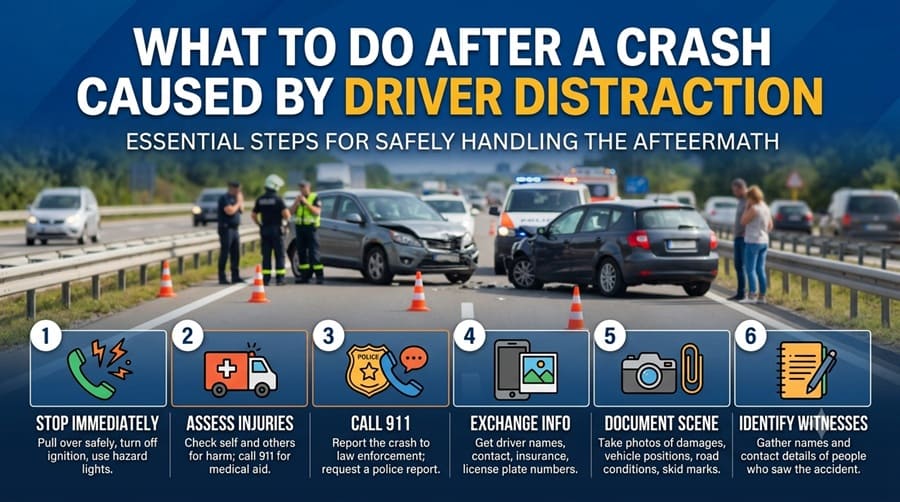
The priority after a collision should be safety. If possible, move to a safe location and contact emergency services when necessary.
Report the Collision
Depending on the circumstances, law enforcement may respond to the scene and prepare a report. A police report can document information about the vehicles, drivers, witnesses, roadway conditions, and statements made after the crash.
California also requires certain collisions to be reported to the DMV. The California DMV states that a collision must be reported within 10 days when it causes more than $1,000 in property damage or when anyone is injured or killed.
Exchange Information
Collect the other driver’s:
- Name
- Contact information
- Driver’s license information
- Insurance information
- License plate number
- Vehicle information
If witnesses are present, obtain their contact information as well.
Document the Accident Scene
Photographs can preserve details that may disappear once vehicles are moved or repaired.
Take Photos From Different Angles
If your condition allows, photograph:
- Damage to your vehicle
- Damage to the other vehicle
- The roadway
- Traffic signals and signs
- Nearby intersections
- Skid marks or debris
- Visible injuries
- Weather or road conditions
Try to capture both close-up images and wider views showing the position of the vehicles and surrounding environment.
Seek Medical Attention
Some injuries are immediately obvious, while others may not become noticeable until later. Adrenaline and stress after a collision can make it difficult to recognize the full extent of an injury.
Keep Medical Records
If you receive treatment, maintain copies of:
- Emergency room records
- Diagnostic imaging
- Physician notes
- Prescriptions
- Physical therapy records
- Medical bills
- Follow-up recommendations
Medical documentation can help establish what injuries occurred and what treatment was necessary.
Track How the Accident Affects Your Daily Life
The financial impact of a collision may extend beyond medical expenses.
A serious injury can result in missed work, reduced earning capacity, transportation expenses, rehabilitation costs, and other losses.
Keep a Personal Accident Journal
Consider maintaining a simple record of:
- Symptoms and pain
- Medical appointments
- Days missed from work
- Activities you can no longer perform
- Changes to your normal routine
- Transportation difficulties
- Ongoing treatment
This information can help create a chronological record of how the injury affected your daily life.
Be Careful When Speaking With Insurance Companies
Insurance companies have a legitimate role in investigating accident claims, but statements made shortly after a collision may be interpreted differently from how you intended them.
Stick to the Facts
Provide accurate information about what happened, but avoid guessing about details you cannot remember.
You should also be cautious about making definitive statements about your physical condition immediately after the accident. Some injuries take time to diagnose or fully understand.
Do Not Rush to Accept a Settlement
An early settlement may not account for future medical treatment, continuing symptoms, lost income, or other consequences that have not yet become clear.
Before accepting an offer, understand what rights you may be giving up and whether the proposed amount addresses your known and anticipated losses.
Avoid Posting About the Accident Online
Social media can create additional complications during an injury claim. Photographs, comments, or statements about the accident may be taken out of context.
Keep Discussions Private
Avoid publicly discussing who caused the collision, how severe your injuries are, or what you plan to do about the claim.
It is generally safer to keep detailed discussions about an accident and potential legal claim between you and the professionals handling the matter.
Consider Whether Legal Representation Is Appropriate
If you were hit by a distracted driver, obtaining legal guidance may be especially useful when there is a disagreement about fault, significant injuries, or substantial financial losses.
California law generally gives injured people two years from the date of a crash to file a personal injury lawsuit, under California Code of Civil Procedure § 335.1. Waiting too long to gather evidence or consult an attorney can make it harder to build a fully documented claim before that deadline arrives.
Situations That May Justify Legal Help
Consider speaking with an attorney if:
- The other driver denies being distracted
- The insurance company disputes liability
- You suffered serious injuries
- You cannot return to work
- Your medical treatment is ongoing
- Multiple vehicles were involved
- Evidence about the collision is disputed
- A settlement offer does not reflect your losses
An attorney can investigate the circumstances, identify potentially useful evidence, communicate with insurers, and evaluate whether the available evidence supports a claim.
Understand That Distracted Driving Is Broader Than Phone Use
Cell phone use receives considerable attention, but it is only one potential source of distraction. The California DMV advises drivers to avoid activities such as looking at navigation systems, interacting with passengers or pets, and changing music while driving.
This distinction can matter when investigating an accident. The absence of phone records does not necessarily mean that distraction played no role in a collision. Other evidence may reveal that a driver was focused on something other than the road.
Preserve Evidence Before It Disappears
Traffic camera recordings may not be retained indefinitely, witnesses may become difficult to locate, and damaged vehicles may be repaired or sold.
For that reason, documenting the accident early can be valuable. Preserve photographs, medical records, correspondence with insurance companies, repair estimates, and witness information.
A careful record of the collision and its consequences can provide a stronger foundation for determining what happened and what losses resulted from the accident.
Authorities & Sources
- California DMV, California Driver’s Handbook — “Do Not Drive Distracted”
- California DMV — Report of Traffic Accident Occurring in California (SR-1)
- California DMV — Driver Distractions (FFDL 28)
- California Vehicle Code — 23123.5, Handheld Wireless Telephone Restrictions
- California Code of Civil Procedure — 335.1, Statute of Limitations for Personal Injury
This article is for general informational purposes only and does not constitute legal advice. Every case is different — speak with a licensed attorney about the specific facts of your situation.


