
By Brodie Roberts, Director, Roberts Litigation (Brisbane, QLD) | Updated September 2026
When something goes wrong on a building project in Queensland, knowing whether the problem is defective work or incomplete work can make or break your complaint. The two categories trigger different rules, different time limits, and different remedies. This guide walks through the distinction, the QBCC complaint process, and what happens when regulatory action alone isn’t enough.
Quick answer: Defective building work has been done but is faulty or below standard. Incomplete work has not been finished, despite being in the contract. QBCC treats them through different pathways, with different evidence requirements and different time limits, so getting the classification right at the outset matters more than most owners expect.
Defective Work vs Incomplete Work: Why the Distinction Matters
The simplest way to understand the difference: defective work is work done badly, while incomplete work is work not finished. QBCC and QCAT treat them differently, and getting the classification wrong can delay a claim or get it rejected outright.
Building defects fall into structural and non-structural categories. Defective work refers to construction that does not meet required standards — whether that’s the contract specifications, the Building Code of Australia, or the QBCC’s Standards and Tolerances Guide. Incomplete work refers to construction that has not been finished or is left undone, such as fixtures never installed or a project abandoned mid-build.
Classification affects which QBCC pathway applies, whether home warranty insurance is available, and what kind of orders can be issued. A direction to rectify addresses faulty workmanship, while incomplete work may instead trigger an insurance claim or a separate completion pathway.
A few concrete examples from the same project make the distinction clearer:
- A shower with a water leak because the waterproofing membrane was poorly applied — that’s defective work.
- A shower where the glass screen was never installed despite being in the contract — that’s incomplete work.
- Tiling laid with uneven spacing and lippage — defective. Tiles delivered to site but never laid — incomplete.
What Is Defective Building Work Under QBCC Rules?
Under Queensland law, defective building work is “faulty or unsatisfactory building work” as defined in the Queensland Building and Construction Commission Act 1991 (the QBCC Act) and related regulations. The QBCC has regulated Queensland’s building industry since 1991, and its standards form the baseline for every defective work complaint.
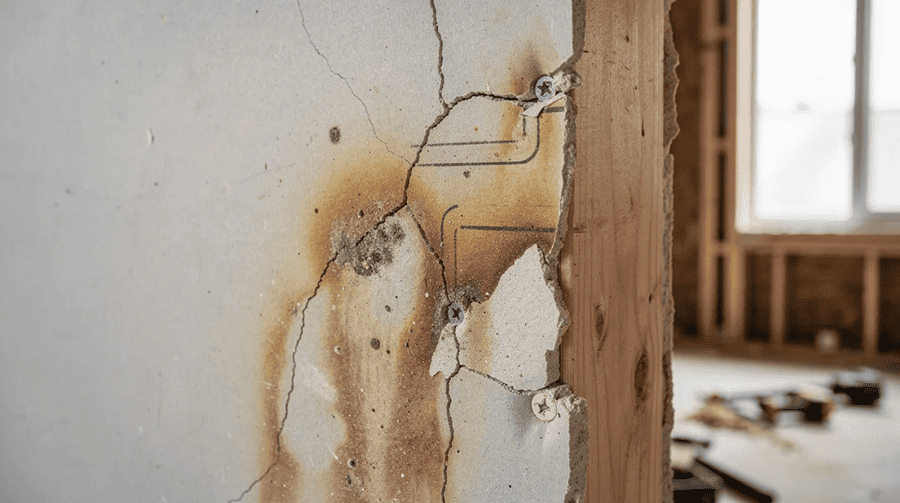
- Defective work often includes faults such as cracks, leaks, and compliance failures. It can be identified during construction or discovered after completion, including latent defects that emerge years later.
- Structural defects affect the safety, structural performance, or functional use of a building — major cracking in loadbearing walls, foundation movement, and failed waterproofing that allows water penetration are typical examples.
- Non-structural defects are usually cosmetic and minor — poor paint finish, uneven tiling, sticking doors, or plaster cracks.
Structural defective building work can also include anything that poses risk of death, grievous harm, or renders the building unfit for its intended use. The QBCC classifies the worst cases as “Tier 1” defects, which can lead to industry bans.
How QBCC Treats Incomplete Building Work
Incomplete work often arises when a builder abandons a project, becomes insolvent, or has their licence cancelled or suspended. The QBCC addresses incomplete work through its dispute resolution process and, for residential work, through the QBCC home warranty insurance scheme when eligibility criteria are met — that scheme covers costs if a contractor becomes insolvent, helping fund completion.
- A new home left at lock-up stage, with no internal lining, electrical fit-off, or plumbing completed.
- A kitchen renovation where cabinets are delivered but not installed.
- A pool shell built but no fencing or filtration system installed despite being part of the contract.
Contract terms still matter in incomplete work complaints — the practical completion date and the defects liability period both remain relevant. Owners often need both a defective work complaint for poor workmanship already done and a separate pathway to deal with incomplete work and the extra cost of completion.
Step 1: Check Your Contract Terms Before You Complain
Before lodging a complaint or sending any formal notice, review the contract thoroughly. This step prevents wasted effort and strengthens your position.
Standard domestic building contracts commonly used in Queensland (HIA, Master Builders) contain defects liability clauses and completion milestones. Locate the relevant clauses covering scope of work, completion date, variations, the defects liability period (typically 6 or 12 months post-completion), and dispute resolution steps.
Some issues are purely contractual disputes — wrong materials, a different layout, or disagreement over a variation. QBCC has limited power over pure contract disputes that don’t involve defective or incomplete work as such. Gathering key documents before starting any complaint matters just as much as the legal analysis: the signed contract, approved plans, variations, progress claims, invoices, emails, and photographs all become part of the evidentiary record.
Step 2: Talk to Your Contractor and Put Concerns in Writing
Direct resolution with the contractor generally has to be attempted first — QBCC expects this before a formal complaint is lodged.
Send a detailed written notice listing each item of alleged defective work and each item of incomplete work separately, including dates, photographs, and references to the relevant contract clause or approved plans. A common approach gives the contractor a defined timeframe, often 14 days, to respond or begin rectification. Keep a communication log of emails, messages, and site meeting notes in case the dispute later goes before QBCC or QCAT.
Reasonable access for the licensed contractor to inspect and rectify is usually required — refusing access can jeopardise a later direction to rectify or an insurance claim. It’s also worth checking the contractor’s licence on the QBCC online register at this stage, particularly if there are signs of insolvency, abandonment, or licence suspension, since that changes which pathway applies.
Step 3: Lodging a Defective Work Complaint With QBCC
Once reasonable attempts to resolve the matter with the contractor fail, property owners can lodge a defective work complaint with QBCC. The complaint form typically requires the property address and description of the work, contractor details including the licence number if known, dates of practical completion or abandonment, whether the contract is still active, and whether the complaint relates to defective work, incomplete work, or both.
Attach supporting documents: the contract and any variations, invoices, photos, expert reports, and any prior written notice or rectification correspondence. This is one of several points in the process where speaking with a QBCC lawyer before lodging can help — getting the classification and the supporting documentation right from the outset avoids a complaint being knocked back on jurisdictional grounds before it’s even assessed on the merits.
QBCC will first check eligibility and jurisdiction, including whether the complaint falls within its time limits and relates to residential or other covered building work. Non-insurable work such as fencing, paving, or landscaping may be excluded entirely.
From Complaint to Direction to Rectify: The QBCC Process
- Early resolution: QBCC assigns a Resolution Services officer who contacts both parties seeking a quick agreement. Initial assessment typically occurs within 4 to 8 weeks, and in some cases QBCC decides no further action is required.
- Site inspection: if early resolution fails, QBCC can arrange a site inspection, comparing the building work against the Standards and Tolerances Guide and the contract specifications.
- Direction to rectify: if defective work is identified, QBCC can direct the licensee to fix it, commonly allowing around 35 days, though timeframes vary with the scale of the work.
Whether QBCC classifies the issue as defective or incomplete can influence insurance eligibility and later tribunal remedies, so the precise wording of a direction to rectify matters well beyond the immediate repair.
Consequences if a Builder Ignores a Direction to Rectify
Ignoring a direction to rectify exposes the contractor to real regulatory and commercial risk. The direction appears on the contractor’s public licence history, visible to anyone checking the QBCC register, and non-compliance can lead to fines, demerit points, and in serious or repeated cases, licence cancellation.
What a direction to rectify cannot do is award the current owner damages or financial compensation — it protects future consumers, but it doesn’t put money back in an owner’s pocket for the defective work or completion costs already incurred. Non-compliance can, however, trigger rights under the QBCC home warranty insurance scheme in eligible residential cases, and owners may still need to pursue separate proceedings in QCAT or the courts to recover consequential losses such as rental costs, business disruption, or the expense of engaging another contractor.
Strict Time Limits for Defective and Incomplete Work Claims
This is where the rules get genuinely confusing, and where getting the timing wrong most often costs owners their rights entirely. There are two different clocks running, and they aren’t the same thing. QBCC’s internal policy thresholds — the timeframes it will ordinarily act within — are 12 months from completion for non-structural defects and roughly 6 years 3 months for structural defects. Separately, section 72A(4) of the QBCC Act sets a hard statutory outer limit: QBCC cannot issue a direction to rectify more than 6 years and 6 months after the work was completed, for any type of defect, unless QCAT grants an extension on QBCC’s own application. Separately again, section 71J of the QBCC Act requires an owner to request QBCC’s intervention within 12 months of becoming aware of the defect, regardless of when the underlying policy threshold would otherwise expire. Missing any one of these three separate deadlines can forfeit the right to a direction to rectify even where the underlying defect is genuine and serious.
Incomplete work claims under the statutory insurance scheme run on their own separate notification dates, often measured from the date of contract termination, abandonment, or licence cancellation rather than from practical completion. Acting promptly once a defect or incomplete item is discovered avoids all of this uncertainty — waiting to “see if it gets worse” is one of the most common and most costly mistakes owners make.
When QBCC Is Not Enough: QCAT and Court Pathways
QBCC is a regulator with the power to direct rectification, not a court that awards damages. This is why owners often need the Queensland Civil and Administrative Tribunal (QCAT) or a court to actually recover money.
QBCC processes generally have to be exhausted before applying to QCAT, which is the first port of call for most residential building disputes once that stage is reached. Larger or more complex disputes — particularly commercial building work or claims involving multiple parties — often proceed in the Magistrates, District, or Supreme Court of Queensland instead, depending on the amount in dispute and its complexity. This overview of proving a breach of contract claim covers the evidentiary standards that carry across from a QBCC complaint into a tribunal or court claim, even though the specific procedures are jurisdiction-specific.
Tribunals and courts will closely examine the contract terms, expert reports on the defective work, the history of any direction to rectify, and QBCC’s own decisions when deciding these claims. Payment disputes and claims for financial loss beyond rectification costs generally require this civil pathway rather than the regulatory one.
How a Construction Lawyer Can Help With Defective and Incomplete Work Disputes
Legal advice becomes genuinely valuable once a dispute moves beyond simple cosmetic defects, or once a contractor has abandoned the project. A construction lawyer can help by:
- Interpreting contract terms to distinguish defective work from a pure contractual scope dispute, and advising on the right forum — QBCC complaint, QCAT, or court.
- Reviewing or challenging a direction to rectify, preparing internal review requests, and handling QCAT review applications of QBCC decisions within the applicable time limits.
- Coordinating expert evidence from engineers and building consultants to prove alleged defects, quantify rectification and completion costs, and respond to allegations against a contractor client.
- Advising on whether a claim falls within QBCC’s regulatory powers or genuinely requires civil proceedings to recover losses.
Construction regulation looks very different from one jurisdiction to the next — Queensland’s QBCC framework has no direct equivalent in most other places, though the underlying idea of separating regulatory rectification from civil compensation shows up elsewhere too. For a sense of how differently a construction-related regulatory regime can be structured, this comparison of how New York’s construction safety statutes developed over time is a useful reference point, even outside the defects context specifically.
Frequently Asked Questions
Is it better to claim my issue is defective work or incomplete work?
Owners shouldn’t choose a label to suit themselves. The correct classification depends on whether the work was carried out but done poorly (defective) or simply not done or finished (incomplete). Misclassifying an issue can complicate QBCC’s assessment and any later QCAT or court proceedings; a thorough inspection often reveals both categories on the same project.
Can I lodge a QBCC complaint while the contract is still active?
Yes, often, particularly where serious defective work is occurring during construction or the contractor refuses to correct issues. Check the contract’s dispute resolution clause and give the contractor a fair chance to rectify first, unless there’s an immediate safety risk.
What if my contractor is unlicensed or their licence is suspended?
This can change eligibility for QBCC assistance and the statutory insurance scheme, particularly for incomplete work. Verify the licence status on the QBCC register immediately and seek specific legal advice, since unlicensed work can expose the contractor to separate penalties.
Does QBCC pay compensation for defective or incomplete work?
No. QBCC issues regulatory decisions like directions to rectify and administers the home warranty insurance scheme for qualifying residential projects, but it does not itself award damages. Recovering broader financial losses generally requires QCAT or court proceedings.
Authorities & Sources
- Queensland Building and Construction Commission Act 1991
- QBCC Standards and Tolerances Guide
- Queensland Civil and Administrative Tribunal (QCAT)
Disclaimer
This article is provided for general informational purposes only and does not constitute legal advice. QBCC processes, statutory time limits, and home warranty insurance eligibility are fact-specific and can change. Reading this article does not create a solicitor-client relationship. Anyone dealing with a defective or incomplete building work dispute in Queensland should seek advice from a Queensland-qualified construction lawyer promptly, given how unforgiving the applicable time limits can be.


