
By W. Calvin Smith II, Founding Partner, Law Office of W. Calvin Smith, II, P.C. | Last reviewed: October 2026
When an accident happens, the first question is usually simple: what went wrong? The harder question comes later, when an injured person has to show who was responsible, and prove it well enough that an insurer or a Bibb County jury will agree. In Georgia, that proof runs through a negligence claim, and a few state-specific rules decide how much a person can recover, or whether they recover anything at all.
Georgia Rules That Shape Every Macon Injury Claim
| Rule | What it means |
| Two-year deadline | Most personal injury lawsuits must be filed within two years of the accident |
| 50% bar | An injured person found 50% or more at fault recovers nothing; below that, recovery is reduced by their share |
| Government notice | Claims against a city, county, or the state require written notice within months, well before the lawsuit deadline |
| 2025 tort reform | For injuries on or after April 21, 2025, juries can hear seat belt evidence and what health insurers actually paid |
What Negligence Means Under Georgia Law
Georgia law expects people to use “ordinary diligence,” the care an ordinarily prudent person would use under similar circumstances (O.C.G.A. § 51-1-2). Failing to do so is negligence. In practice, every negligence claim has to answer four questions:
- Duty: Did the other person owe a duty of care? Every driver owes one to others on the road.
- Breach: Did they fail to meet it, for example by speeding, following too closely, or using a phone?
- Causation: Did that failure actually cause the crash and the injury?
- Damages: Did the injured person suffer real, documented losses?
Traffic laws often help with the breach question. Georgia prohibits following more closely than is “reasonable and prudent” (§ 40-6-49) and bans holding or using a phone while driving under the Hands-Free Georgia Act (§ 40-6-241). A violation isn’t automatically the end of the analysis, but it is strong evidence that the driver fell below the standard of care.
The Evidence That Proves Fault
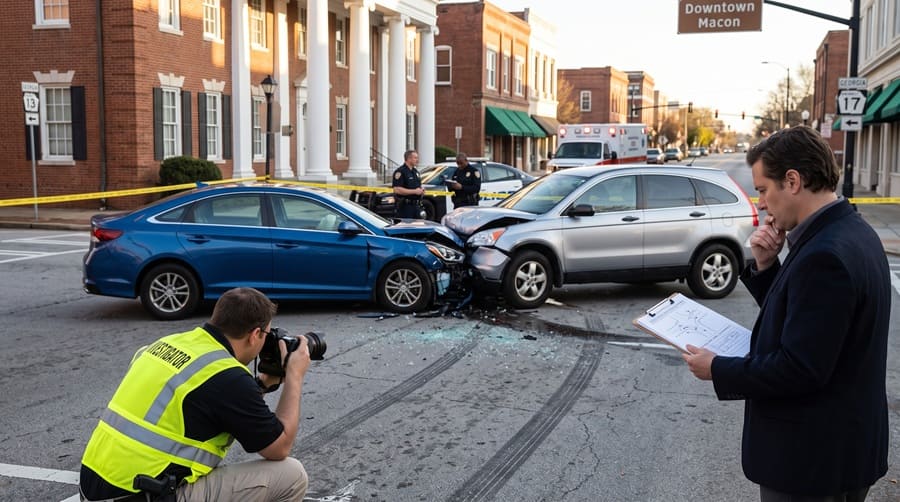
Evidence from a Macon crash can disappear quickly: vehicles get repaired, skid marks fade, and store or traffic cameras record over footage within days or weeks. The evidence that usually matters most includes:
- The police report. Georgia requires crashes involving injury, death, or significant property damage to be reported to law enforcement ( 40-6-273). The report records the scene, statements, and any citations, though the officer’s opinion about fault isn’t the final word.
- Photos and video: vehicle damage, the final resting positions of the cars, road conditions, signs and signals, and surveillance or dashcam footage from nearby businesses along corridors like Eisenhower Parkway or Riverside Drive.
- Witnesses: names and contact information of anyone who saw the crash, gathered before they scatter.
- Vehicle data: event data recorders in many cars can show speed and braking in the seconds before impact; commercial trucks often carry more detailed electronic records.
This checklist of what information to collect after an accident is a useful starting point at the scene.
Causation and Medical Evidence
Showing that someone drove carelessly is only half the case. The injured person must also show the carelessness caused the injury. Prompt medical care creates the clearest record. Whiplash, soft tissue injuries, and concussions often become more noticeable hours or days later, and a gap between the crash and the first doctor visit is one of the first things an insurer will point to.
Consider a rear-end collision. Photos of the damage, the police report, and a witness who saw the trailing car closing too fast can establish how the crash happened. Emergency room notes, imaging, and a physician’s opinion that the neck injury is consistent with the collision then connect the crash to the harm. Each piece of evidence does a different job.
Damages and Georgia’s 2025 Changes
Recoverable damages generally include medical expenses, lost wages and earning capacity, property damage, and pain and suffering. Keep every bill, pay stub, and a short journal of how the injury affects work, sleep, family responsibilities, and ordinary activities.
Georgia’s 2025 tort reform law (SB 68) changed how some of these damages are proven (summary). For injuries on or after April 21, 2025, juries can hear both what medical providers billed and the amounts actually paid by health insurance, and evidence about whether the injured person was wearing a seat belt can be considered in assessing fault and causation. The law also limits how attorneys may suggest specific dollar amounts for pain and suffering. These changes make careful documentation of treatment and the circumstances of the crash more important than before.
Georgia’s Comparative Fault Rule: The 50% Bar
Fault is often shared. Under O.C.G.A. § 51-12-33, Georgia follows a modified comparative fault rule: if the injured person is found 50% or more responsible, they recover nothing. Below that, their recovery is reduced by their percentage of fault. A person with $100,000 in damages who is found 20% at fault would recover $80,000; at 50%, they would recover nothing.
Georgia also applies an avoidance rule: a plaintiff who could have avoided the consequences of the other party’s negligence by using ordinary care may be barred from recovery (§ 51-11-7). That is why the difference between 30% and 50% fault, and the evidence behind it, matters so much. For a broader look at shared-fault claims, see whether you can sue if an accident was partly your fault.
For a closer look at the evidence attorneys use to establish each element, see this explanation of how negligence is proven in a Macon accident claim.
When More Than One Party Is Responsible
Negligence doesn’t always stop with the driver. Employers can be responsible for employees driving on the job, and a vehicle owner who lends a car to someone they know is unfit to drive may be liable for negligent entrustment. Among the results Calvin Smith Law lists on its case results page is a $2,750,000 recovery in a negligent entrustment case. The firm’s page doesn’t describe the underlying facts, but the claim type itself shows why investigation matters: identifying who owned the vehicle, who allowed it to be driven, and what they knew about the driver can add a responsible party, and an additional insurance policy, that a quick review would miss.
Negligent entrustment claims in Georgia generally require evidence that the owner knew the driver was incompetent or reckless, such as a suspended license, prior wrecks, or known impairment. That evidence rarely appears in a police report; it comes from records requests, witness interviews, and discovery.
Past results do not guarantee similar outcomes. Every case depends on its own facts.
Deadlines You Can’t Miss
- Two years for injury claims. Most personal injury lawsuits in Georgia must be filed within two years of the injury (C.G.A. § 9-3-33).
- Ante litem notice for government claims. If a city vehicle, county road defect, or government employee was involved, written notice is required much sooner: six months for claims against municipalities ( 36-33-5) and twelve months for claims against counties (§ 36-11-1). Because Macon and Bibb County operate as a consolidated government, which deadline applies can itself be a legal question, so act early.
Practical Steps After a Macon Accident
- Call 911 and report the crash; get medical care the same day if possible.
- Photograph the vehicles, scene, signals, and your injuries.
- Get witness names and note nearby businesses that may have cameras.
- Keep all medical records, bills, and proof of missed work.
- Give insurers accurate facts without guessing about speeds, distances, or fault.
For general crash prevention and safety information, the National Highway Traffic Safety Administration publishes research and guidance on distracted driving, seat belts, and other risk factors. Georgia’s statutes are searchable through the Official Code of Georgia.
Frequently Asked Questions
How do you prove negligence in a Georgia car accident?
By showing the other driver owed a duty of care, breached it, caused the crash and injury, and that you suffered documented damages, usually with police reports, photos, witnesses, vehicle data, and medical records.
Can I recover if I was partly at fault in Georgia?
Yes, if you were less than 50% at fault. Your recovery is reduced by your share of fault. At 50% or more, you recover nothing.
How long do I have to file an injury claim in Macon?
Generally, two years from the accident. Claims involving a government entity require written notice much sooner, often within six to twelve months.
Does not wearing a seat belt affect my claim in Georgia?
For injuries on or after April 21, 2025, seat belt evidence can be considered in assessing fault and causation under Georgia’s 2025 tort reform law.
Can someone other than the driver be liable?
Sometimes. Employers, vehicle owners who negligently entrust a car to an unfit driver, and parties responsible for road defects or vehicle parts may share liability.
Disclaimer
This article provides general information about Georgia negligence law and is not legal advice. Reading it does not create an attorney-client relationship. Laws change, including the 2025 tort reform provisions, and outcomes depend on the facts of each case. For advice about your situation, consult a licensed Georgia attorney.


