
By Maria A. Dominguez-Victoriano, Founding Partner, DMRA Law, LLC · Member of The Florida Bar; former Assistant State Attorney, Miami-Dade | Updated November 2026
Since July 1, 2023, Florida has let qualifying adults carry a concealed gun in public without first applying for or getting a state license, under section 790.01 of the Florida Statutes. Two appellate decisions since then have changed the picture again, one on open carry and one on age.
That run of changes led some people to assume the rules had largely disappeared. They have not. Miami gun owners still face clear legal limits on who may carry, where, and how. Crossing those lines can lead to serious criminal charges.
What Changed, in Short
- July 2023: Permitless concealed carry took effect for adults who meet the license eligibility criteria.
- September 2025: A Florida appellate court struck down the open carry ban, and the state stopped enforcing it.
- June 2026: A Florida appellate court struck down the age-21 floor for concealed carry, opening carry to eligible 18- to 20-year-olds.
- Unchanged: The list of places where guns are banned, the rules on who is prohibited from having a gun, and the crimes for misusing one.
Who Can Carry Without a License
The test for carrying without a license is the same one used for the license itself under section 790.06. A person has to be free of anything that would rule them out, such as a felony conviction, a misdemeanor domestic violence conviction, certain drug or alcohol-related findings, a recent commitment, or an active injunction against them.
The age requirement is the biggest recent change. The statute still says 21, but on June 17, 2026, Florida’s Fourth District Court of Appeal held in Eubanks v. State that the age-21 requirement is unconstitutional as applied to adults 18 to 20. The Florida Department of Agriculture and Consumer Services notes that the Attorney General will not seek further review and that, because no other appellate court has ruled on the issue, the decision is effectively statewide law. That ruling deals with carrying. Buying a gun from a licensed dealer still has separate age rules under state and federal law.
People who carry without a license must have valid identification with them and show it to a law enforcement officer on request.
Anyone uncertain about eligibility should resolve that question before carrying. Prior arrests, old convictions, sealed or withheld adjudications, and injunctions can create disqualifications that are not obvious. When charges do arise, people often contact a Miami weapons charges attorney to review whether the carry was lawful in the first place.
Places Where Carrying Is Still Prohibited
Section 790.06(12) lists places that stay off-limits, licensed or not. Among them:
- courthouses and courtrooms
- police, sheriff, and highway patrol stations, and any jail or detention facility
- polling places
- schools, school administration buildings, and school events, with limited exceptions
- college and university facilities
- school, college, or professional athletic events not related to firearms
- the bar side of a restaurant, or any part of a business licensed to serve alcohol on site that is mainly devoted to drinking
- airport passenger terminals and anywhere past the security checkpoint
- meetings of government bodies and legislative sessions
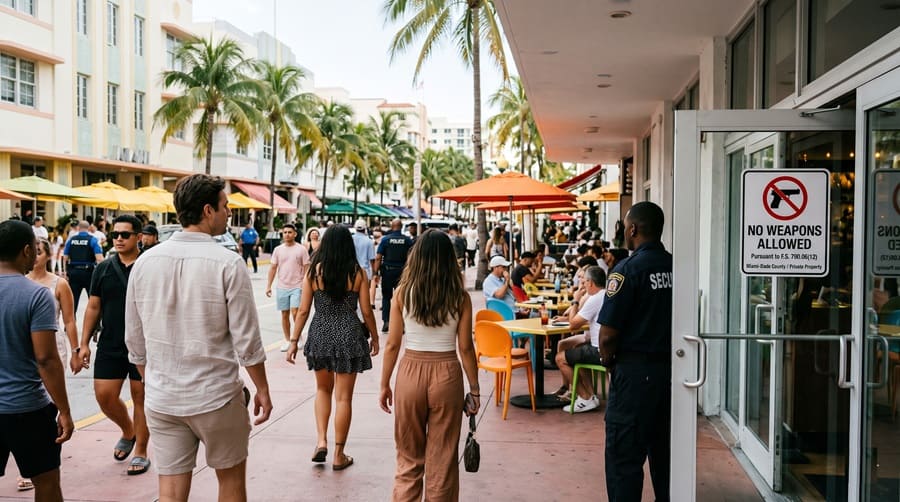
Federal property follows separate rules of its own, including federal courthouses and post offices. A store, gym, or office can also post a no-guns policy. A gun owner who refuses to leave when asked can face a trespass charge even though the carry itself was legal, and under section 810.08, trespass in a structure or vehicle while armed with a firearm is a third-degree felony, not the misdemeanor most people expect.
Open Carry After McDaniels
Florida long prohibited open carry in most situations, with narrow exceptions such as fishing, hunting, and camping. On September 10, 2025, the First District Court of Appeal ruled in McDaniels v. State that the open carry ban in section 790.053 violates the Second Amendment. The Attorney General declined to seek further review and directed prosecutors and police statewide to stop arresting law-abiding adults solely for carrying a visible firearm.
More than a year later, open carry is treated as lawful for adults who may legally carry, but three cautions apply. First, section 790.053 is still printed in the statutes, because the Legislature did not repeal it, so the legal footing rests on a court decision and an enforcement directive. Second, every location restriction above applies to open carry the same way it applies to concealed carry. Third, displaying a firearm in a rude, careless, angry, or threatening way is still a crime under section 790.10, and a visible gun in a heated moment can turn into that charge quickly.
Why a License Still Matters
Even with permitless carry, Florida still issues concealed weapon licenses. The Florida Department of Agriculture and Consumer Services explains the process. A license can offer practical benefits:
- reciprocity that allows carry in many other states
- an exemption from Florida’s three-day waiting period when buying a handgun
- clear documentation of eligibility if an officer or business questions it
Vehicles and Transport
Under section 790.25, a gun can ride in a private car if it is securely encased or not readily accessible, and eligible adults can now carry concealed inside the vehicle as well. “Securely encased” means in a glove box, a snapped holster, a zipped gun case, or a closed box or container that needs a lid or cover to be opened.
Rules change when crossing state lines. Travelers heading outside Florida should check each state’s laws before leaving, especially states that do not honor Florida licenses or permitless carry. Flying with a firearm requires following airline and TSA rules, including declaring the firearm and packing it unloaded in a locked hard-sided case. Bringing a gun to the checkpoint at Miami International Airport, even by mistake, can lead to both a federal civil penalty and a state charge.
Common Charges Gun Owners Face
Weapons cases have not dried up in Miami-Dade since the law changed. Prosecutors still bring charges for carrying in a banned location, carrying while ineligible, improper exhibition, armed trespass, and gun possession by someone with a felony record, which is a second-degree felony.
The penalties run from misdemeanors up to felonies that carry required minimum sentences. Under Florida’s 10-20-Life law, possessing or using a firearm during certain felonies triggers mandatory minimum prison terms, which makes these cases far more serious than many people expect. The timing of a law change can also matter to a pending case, as this explanation of how statutory changes apply to a Florida criminal case describes.
Rights During a Stop or Arrest
A traffic stop can turn tense fast once a gun is in the car. Florida law does not require a driver to tell an officer about a firearm unless asked, but keeping calm, leaving both hands in plain view, and telling the officer about the firearm before reaching for anything usually lowers the temperature. Answer questions about the gun truthfully if you choose to answer at all.
This overview of rights when you are arrested covers the right to remain silent and the right to a lawyer, both of which apply in a weapons case the same as any other.
Knowing the Lines
Permitless carry, McDaniels, and Eubanks changed who can carry and how. None of them removed the limits on where firearms can be carried or who can lawfully possess them. For Miami gun owners, understanding those lines remains the most reliable protection against unintended criminal charges.
Disclaimer
This article is a general summary of Florida carry rules and is not legal advice. Reading it does not create an attorney-client relationship. Florida gun law has changed several times since 2023 and may change again, so anyone facing a charge should speak with a licensed Florida criminal defense attorney. Results in past matters do not guarantee or predict the outcome of any future case.


