
By H. Patterson “Pat” McWhirter, Founding Shareholder, McWhirter, Bellinger & Associates, P.A., Columbia · Updated November 2026
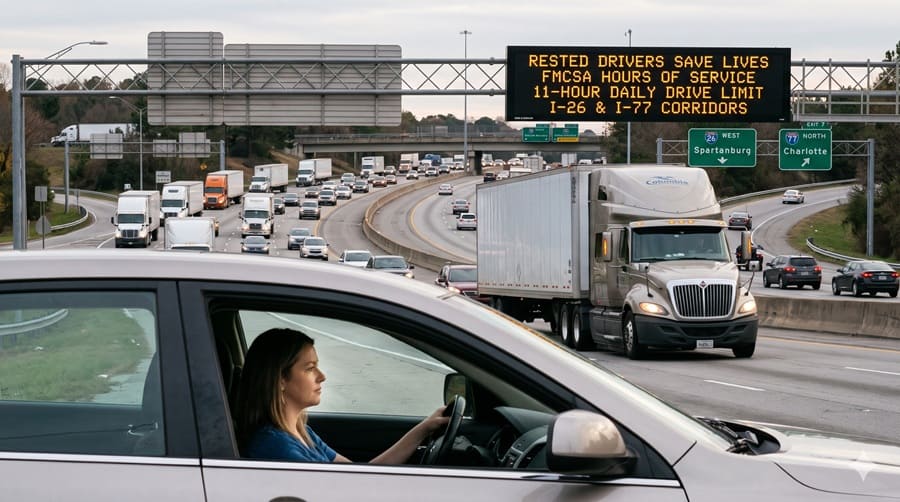
Columbia sits at the crossroads of three major interstates. Interstate 26 links the Upstate with Charleston’s port. Interstate 77 runs north toward Charlotte. Interstate 20 crosses the state from Augusta to Florence. Heavy trucks use all three constantly.
The interchange where I-20 and I-26 meet, long known locally as Malfunction Junction, has been under reconstruction for years through SCDOT’s Carolina Crossroads project precisely because of its traffic volume. Lane shifts, narrowed shoulders, and sudden slowdowns in a work zone leave little margin for a tired truck driver.
Why Driving Hours Are Regulated
Drowsy truckers have worried safety officials for decades. Long shifts, schedules that flip between day and night, and tight delivery windows can wear a driver down to the point of danger. A fully loaded tractor-trailer can weigh up to 80,000 pounds and needs far more distance to stop than a car, so a second or two of delayed reaction matters.
The federal answer was a set of hours-of-service limits that cap how long a commercial driver may stay behind the wheel. After a wreck, those limits are often among the first things investigators check. People hurt in such crashes frequently reach out to truck accident lawyers in Columbia, SC to obtain and interpret the driver’s logs before they disappear.
The Core Rules
The FMCSA hours-of-service regulations cover most truckers hauling freight across state lines. The key limits for property-carrying drivers appear in 49 C.F.R. § 395.3:
| Rule | Limit |
| Driving per shift | 11 hours, after at least 10 consecutive hours off duty |
| Duty window | No driving after the 14th hour since coming on duty, even with breaks |
| Rest break | 30 minutes after 8 cumulative hours of driving |
| Weekly limit | 60 hours in 7 days or 70 hours in 8 days |
| Restart | 34 or more consecutive hours off resets the weekly total |
Drivers with a sleeper berth can split their 10-hour off-duty period, for example, into 7 and 3 hours or 8 and 2 hours, as long as one part is spent in the berth. Passenger carriers such as bus companies follow a separate, stricter set of limits.
Where the Rules Fall Short
The limits are ceilings, not promises of a rested driver. Someone can follow them to the minute and still be worn out. Poor sleep, untreated sleep apnea, and night driving all increase fatigue.
The rules also contain exceptions that can stretch a shift. Under 49 C.F.R. § 395.1, a driver who runs into unexpected adverse driving conditions, such as bad weather or an unforeseen traffic jam, may extend both the 11-hour and 14-hour limits by up to 2 hours. A short-haul exception lets drivers who stay within 150 air miles of their home terminal skip the daily log, using time records instead. Personal conveyance, which allows a driver to move a truck off duty for personal reasons, is sometimes misused to hide driving time.
How Logs Are Recorded
Electronic logging devices on most interstate rigs record driving time automatically from the truck’s engine, without the driver typing it in. These records show when the truck was moving, how long the driver had been on duty, and when breaks were taken. Drivers can annotate or propose edits, but the device keeps the original record.
After a crash, logs can be compared with fuel receipts, toll records, GPS and telematics data, bills of lading, and delivery schedules to check accuracy. Gaps, unassigned driving time, or edits made after the crash often deserve a closer look.
Carrier Responsibility
The carrier’s duties go further than the driver’s own choices. Carriers that set unrealistic schedules, ignore violations, or fail to monitor drivers may share liability for a crash. A carrier that knowingly allows or requires a driver to exceed the hours limits also violates federal rules itself.
Dispatch records and communications between drivers and the company can reveal pressure to keep driving. Pay structures matter too, since drivers paid by the mile may feel pushed to keep moving rather than rest. A company’s own safety record, including its federal inspection history, can show whether hours violations were a pattern.
When a Tractor-Trailer Doesn’t Stop in Time
Rear-end collisions are among the crash types most often linked to a driver who is slow to react. One result listed on McWhirter, Bellinger & Associates’ results page involved a client who was rear-ended by a tractor-trailer, a claim that resolved for $475,000. The firm’s summary does not say whether fatigue played a role. In cases like it, though, the driver’s logs, the truck’s braking data, and the time since the driver’s last rest are usually among the first records requested.
Each case turns on its own facts and the applicable law, and prior results do not guarantee or predict the outcome of another case.
South Carolina Law
South Carolina weighs fault by percentage. Under the rule the state Supreme Court adopted in Nelson v. Concrete Supply Co. in 1991, an injured driver can still collect while their share of fault is no greater than the defendants’ combined share, and the award drops by that share. At 51 percent, recovery is barred.
Most injury suits in the state have to be filed within three years under S.C. Code section 15-3-530, as this overview of South Carolina personal injury statutes of limitations explains. Claims against a state or local government agency generally follow the shorter limits of the South Carolina Tort Claims Act.
The evidence clock runs much faster. Under federal rules, carriers must keep drivers’ records of duty status and supporting documents for six months, and dash camera footage may be overwritten far sooner. A written preservation letter asking the carrier to keep logs, ELD data, video, dispatch messages, and maintenance records is a common first step.
Safety Starts With Drivers
Many truck drivers take fatigue seriously and plan their routes carefully. These essential safety tips for new truck drivers were written for Missouri roads, but many apply on South Carolina highways too. Good habits include planning rest stops in advance, avoiding driving during the body’s natural low points in the early morning hours, and refusing loads that require unsafe schedules.
Sharing the Road Safely
Passenger vehicle drivers can reduce risk around large trucks by:
- staying out of blind spots on all four sides
- passing quickly and safely rather than lingering beside a truck
- leaving extra space when merging in front of a truck
- watching for signs of a tired driver, such as drifting between lanes or inconsistent speed
Rules That Protect Everyone
Hours-of-service rules exist because fatigue kills. On busy corridors like I-26 and I-77, those rules protect truck drivers and everyone around them. When a crash happens, understanding the rules and preserving the records quickly helps reveal whether fatigue played a role.
Disclaimer
This article is general information on trucking hours rules and South Carolina law and is not legal advice. Reading it does not create an attorney-client relationship. Speak with a licensed South Carolina attorney about the facts of any real collision.


