
By D’Angelo M. Lowe, Founder and Managing Attorney, The Insurance Outlaw (Lowe Law, PLLC), Houston · Updated November 2026
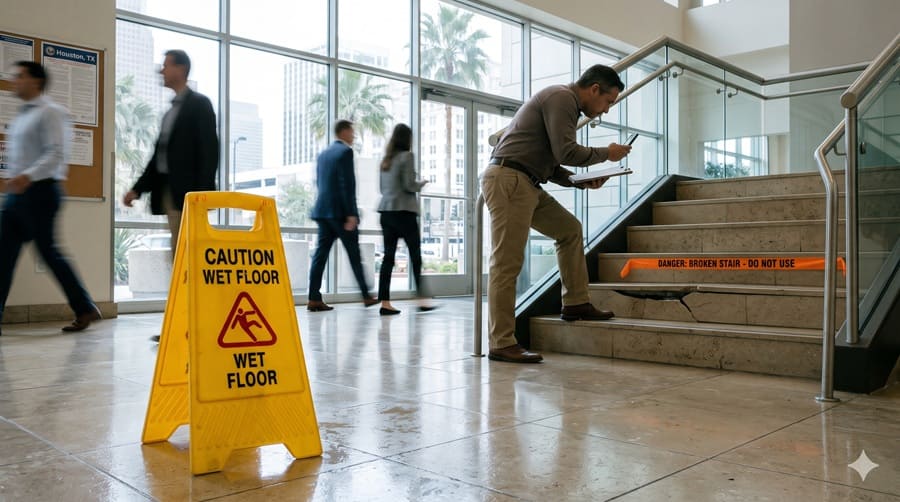
Spilled water by the produce bins. A wobbly stair rail at an apartment building. A parking garage gone dark because of a burned-out bulb. Houston has thousands of stores, restaurants, offices, and rental properties, and every one of them has a legal duty toward the people who visit.
When that duty is ignored, and someone gets hurt, a premises liability claim may follow. These claims move through a fairly predictable sequence, and understanding each stage helps injured people avoid common mistakes. In Texas, the stage that decides most store fall cases is the third one: proving how long the hazard was there.
Stage One: The Injury and the Report
It all starts with the moment someone gets hurt, whether that is a slip on a wet aisle, a railing giving way, or some other hazard on the property.
Telling the manager or owner right away puts the incident on paper. Ask for a copy of the incident report, or at least write down the name of the person who took it. Snapping pictures of the hazard before anyone mops it up or fixes it may matter even more, especially photos that show footprints, cart tracks, or dirt in a spill, because those details suggest it had been there a while.
Stage Two: Identifying the Visitor’s Status
Texas sorts visitors by the reason they were there:
- invitees, like customers, who come for the owner’s business
- licensees, like a friend at a barbecue, who are allowed in for their own purposes
- trespassers, who were never allowed in
Customers get the most protection. An owner has to fix hazards it knew about, or reasonably should have caught, or at least warn customers about them. A licensee is generally owed a warning only about dangers the owner actually knew of and the visitor did not. A trespasser can usually recover only if the owner acted willfully, wantonly, or with gross negligence.
Status questions can be tricky. Houston practices such as The Insurance Outlaw premises liability legal team often begin a review by sorting out exactly which category a visitor falls into.
Stage Three: Proving What the Owner Knew
A customer’s case usually turns on four points: the owner knew, or should have known, about the hazard; the hazard posed an unreasonable risk of harm; the owner did not take reasonable care to fix it or warn about it; and that failure caused the injury.
Constructive knowledge turns on time. In Wal-Mart Stores, Inc. v. Reece (2002), the Texas Supreme Court adopted what lawyers call the time-notice rule: the injured person generally has to show the hazard existed long enough that a reasonable inspection would have found it. An employee standing nearby is not enough on its own. Courts look at how close employees were, how noticeable the hazard was, and how long it had been there. The court reaffirmed that rule in April 2026 in H-E-B, LP v. Peterson, as a recent Fifth Circuit opinion applying Texas law notes. In practice, a puddle with no evidence of how long it sat there is often a losing case, while video showing it sat for 20 minutes is a very different one.
Surveillance footage, inspection and sweep logs, and employee testimony can all help establish how long a hazard existed. Owners also argue that a hazard was open and obvious. Since Austin v. Kroger Texas (2015), an owner generally has no duty to warn about a danger that is open and obvious or already known to the visitor, though there are narrow exceptions.
Stage Four: Measuring the Damages
Money in these cases falls into two broad buckets. One holds losses with a receipt attached, like hospital bills and missed paychecks. The other covers harms without a price tag, such as pain, mental anguish, and lasting physical limits. This explainer on general and special damages in personal injury cases helps clarify how these categories are calculated.
Texas has a specific rule on medical bills: recovery is limited to the amount actually paid or incurred, not the full sticker price on the bill. That often makes the billed amount and the recoverable amount very different numbers.
Stage Five: Negotiation With the Insurer
In most cases, the owner’s insurer runs the claim, and an adjuster weighs the proof, the medical file, and who was to blame. The usual pushback is that the danger was plain to see, that the visitor was not watching, or that the owner could not reasonably have known about it.
Fault also matters here. Under Chapter 33 of the Civil Practice and Remedies Code, a visitor who is half to blame or less can still be paid, minus that share, while one who is more than half to blame gets nothing. Footwear, phone use, and whether the visitor walked past warning signs all tend to come up.
A Restaurant Fall That Reached Resolution
The Insurance Outlaw’s case results page lists a $750,000 recovery for a client who slipped and fell in a national chain restaurant. The page does not describe the hazard or how notice was proven, but restaurant cases like it typically turn on the same questions covered above: whether staff knew or should have known about the condition, how long it was there, and whether the injuries are well documented.
Each case depends on its own facts and evidence, and a past result does not guarantee or predict the outcome of any future case.
Stage Six: Filing Suit if Needed
When talks stall, filing suit is the next step, and the usual two-year limit for that appears in Chapter 16 of the Texas Civil Practice and Remedies Code.
Claims against government property owners are different. Under the Texas Tort Claims Act, a government unit must generally receive written notice within six months, and the City of Houston’s charter shortens that to 90 days for claims against the city. The government also usually owes a visitor only the lower duty owed to a licensee, unless the person paid to use the property, under section 101.022. A fall on a broken city sidewalk or in a county building is a case where those rules can decide everything.
Special Situations
Some premises cases follow different rules. Apartment complexes have duties related to security and repairs, and Texas law gives tenants specific repair remedies. Retail stores often have detailed inspection policies, and whether employees followed them can matter. Injuries caused by criminal acts on a property depend on whether the crime was foreseeable, which Texas courts measure by looking at prior similar crimes on or near the property, how recent and frequent they were, and whether the owner knew about them.
Each situation requires a careful look at the facts and the property owner’s practices.
Protecting the Claim
The strongest premises claims usually share a few features:
- prompt reporting and documentation
- photographs of the hazard, the surrounding area, and your shoes
- witness names and contact information
- consistent medical treatment without long gaps
- early written requests to preserve video footage
Video is often overwritten within days or weeks, so speed matters. For more on when outside help makes sense, see this piece on hiring a lawyer for a slip and fall injury case.
From Incident to Resolution
Premises liability claims in Houston follow a logical path, from the injury through evidence, damages, and negotiation. Knowing each stage helps injured people protect their rights and make informed decisions along the way.
Disclaimer
This article is general background on Texas premises liability and is not legal advice. Reading it does not create an attorney-client relationship. Anyone hurt on a Houston property should get a licensed Texas attorney’s view of their own situation before making decisions.


