
By Gordon J. Heuser, Founding Partner, Heuser & Heuser, L.L.P., Colorado Springs · Updated November 2026
Colorado Springs has grown quickly, and its roads show it. Traffic on Interstate 25, Powers Boulevard, and Academy Boulevard has increased, and so has the number of drivers glancing down at a screen at exactly the wrong moment.
Injured people tend to raise the same handful of questions, taken one at a time below.
How Common Is Distracted Driving?
More common than most people think. The National Highway Traffic Safety Administration reports that distracted driving kills thousands of people in the United States every year, and many more are injured. In Colorado, the Colorado Department of Transportation counts 676 people killed in distracted driving crashes from 2014 to 2024 and ranks distraction as the third most common contributing factor in the state’s crashes. CDOT also notes that distraction is often underreported, because officers usually depend on an admission or a witness to record it.
Anything that pulls attention off the road counts: a phone, a navigation screen, a burger, a chatty passenger, even daydreaming. Phones are the worst of the bunch, because they take a driver’s eyes, hands, and mind all at once.
What Does Colorado Law Say About Phones?
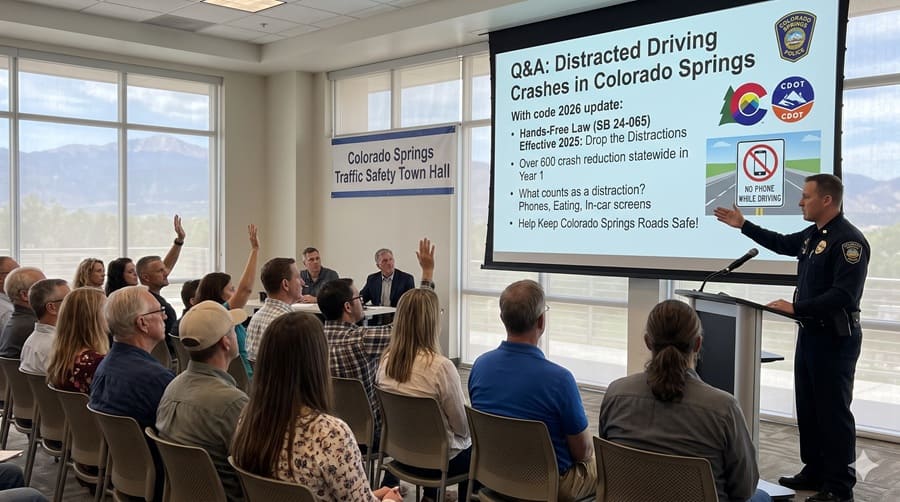
Colorado got stricter on January 1, 2025. Under the hands-free law passed as Senate Bill 24-065, no driver of any age may hold or handle a phone or other mobile device while driving, aside from a few exceptions like reporting an emergency. That includes sitting at a red light or stopped in traffic, not just when the car is moving. Drivers under 18 face a stricter rule and generally may not use a phone at all, even hands-free, except in an emergency.
Voice commands, Bluetooth, and built-in systems like CarPlay or Android Auto are still allowed for adults. The penalties climb with each ticket:
- first offense: $75 and 2 license points, which can be dismissed once if the driver shows proof of buying a hands-free accessory
- second offense within 24 months: $150 and 3 points
- third or later offense within 24 months: $250 and 4 points
The early numbers suggest the law is having an effect. CDOT reports that Colorado State Patrol issued 216 percent more device citations in 2025 than in 2024 and investigated 3,778 crashes involving inattentive drivers, a decline of about 9 percent.
How Is Distraction Proven After a Crash?
Distraction is hard to pin down, since few drivers will say they were looking at a phone. Evidence may include:
- witness statements describing the driver’s behavior
- phone records showing calls, texts, or data use at the time of the crash
- vehicle data or dash camera footage, including footage from nearby businesses or traffic cameras
- the driver’s own statements to police
- crash patterns that suggest a late reaction, such as no skid marks before a rear-end impact
Phone records often require a subpoena or court order, and carriers do not keep every type of data forever. People who believe the other driver was distracted sometimes contact the Heuser & Heuser injury law firm or other counsel, since obtaining and interpreting those records takes time and should begin early.
Does the Other Driver’s Ticket Settle Who Was at Fault?
No, though it helps. A hands-free citation is useful support, and a violation of a safety law can be evidence of negligence. But a civil case makes its own call on fault, and a ticket can be dismissed or never written at all. Proof of how the collision unfolded still carries the most weight.
What If Both Drivers Were Distracted?
Colorado assigns fault in percentages under its comparative negligence statute. A hurt driver can still be paid if their share is smaller than the other side’s, and the payout drops by that share. At 50-50, the injured driver recovers nothing.
If both drivers were distracted, the specific facts determine how fault is divided. A driver who looked at a phone for a second may be treated differently from one who was reading a long message when the crash happened. Colorado also limits some categories of damages by statute, which this overview of compensation under Colorado tort law explains.
A Rear-End Crash and What It Shows About Proof
Rear-end collisions are the crash type most often tied to a driver looking away at the wrong moment. One result on Heuser & Heuser’s reviews and results page involved a client who was rear-ended and suffered neck and back injuries, along with frequent headaches and dizziness that required physical therapy. The claim resolved for $173,000. The firm’s summary does not say whether the other driver was on a phone, but cases like it usually turn on the same questions this article covers: how the crash happened, what the records show, and how the injuries were documented.
Every claim depends on its own facts, and a past result does not guarantee or predict the outcome of any other case.
Are Commercial Vehicles Treated Differently?
Yes. Colorado’s hands-free law does not cover commercial motor vehicle operators, who are governed by federal rules instead. Federal regulations prohibit interstate commercial drivers from texting or holding a phone while driving, and a trucking company can face penalties for allowing it. Colorado State Patrol investigated 316 commercial vehicle crashes involving distracted driving in 2025.
Buses, delivery vans, and trucks can cause serious injuries in crashes. This overview of bus accidents and accident lawyers in Colorado covers some of the issues unique to those cases, such as multiple insurers and government operators.
How Much Time Does an Injured Driver Have?
Colorado generally gives car crash victims three years to file suit for injuries from a motor vehicle collision. Public vehicles change the math: under the Colorado Governmental Immunity Act, a claim against a city bus, a Mountain Metro vehicle, or a similar government vehicle usually needs written notice within 182 days of discovering the injury.
Miss that date and the claim is gone, even if the other driver was caught on camera texting.
What Should Someone Do Right After a Crash?
The first steps after a crash can shape the entire claim:
- call police and request a report
- photograph vehicles, the scene, and injuries
- ask witnesses whether they saw the other driver using a phone, and get their contact information
- seek medical care promptly
- avoid discussing fault with the other driver or insurer
Jotting down what happened the same day helps too. Details such as a driver looking down, drifting within the lane, or reacting late are easy to forget within days.
Can Drivers Reduce Their Own Risk?
Yes. Simple habits make a real difference:
- placing the phone out of reach or in a mount before driving
- setting navigation before leaving
- using do-not-disturb driving modes
- pulling over to a safe spot to handle calls or messages
The Bottom Line
Distracted driving remains one of the most preventable causes of crashes in Colorado Springs. The state’s hands-free law reflects that reality. For injured people, understanding how distraction is proven, how fault is shared, and how long they have to act helps protect their right to compensation.
Disclaimer
These answers are general information for Colorado Springs drivers and are not legal advice. Reading them does not create an attorney-client relationship. Take the facts of an actual crash to a licensed Colorado attorney before relying on any of it.


