
By Jason A. Helsel, Partner, Fowler | Helsel | Vogt, Fresno · Updated November 2026
For decades, California’s minimum auto insurance requirements barely changed. The old limits were set in 1967, long before modern medical costs and vehicle prices, and they covered very little in a serious crash.
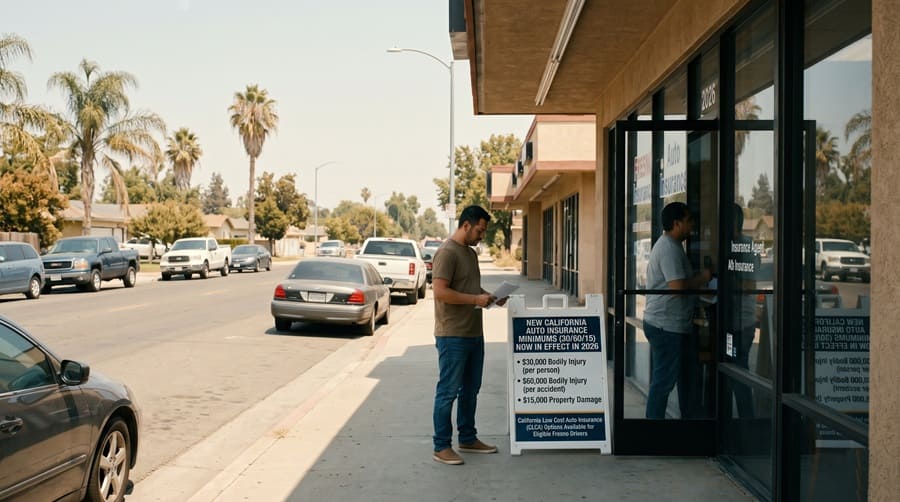
That changed on January 1, 2025. Under Senate Bill 1107, California’s required minimum liability coverage doubled for injuries and tripled for property damage, and every policy issued or renewed since then must meet the new standard. For Fresno drivers, the change affects both what they pay and what protection they carry, and a second increase is already scheduled.
The Old Limits, the New Ones, and the Next Step
| Coverage | Through 2024 | Since Jan. 1, 2025 | From Jan. 1, 2035 |
| Injury or death, one person | $15,000 | $30,000 | $50,000 |
| Injury or death, two or more people | $30,000 | $60,000 | $100,000 |
| Property damage | $5,000 | $15,000 | $25,000 |
The limits are set in Vehicle Code section 16056. The California DMV outlines the current figures on its insurance requirements page, along with information on acceptable proof of coverage. One exception: drivers in the state’s California Low Cost Auto Insurance Program, which serves income-eligible drivers, carry lower limits of $10,000, $20,000, and $3,000. A crash with one of those drivers can leave even less coverage available.
Why the Change Happened
The old minimums had not kept pace with costs. A single emergency room visit, a short hospital stay, or a newer car could easily exceed $15,000. When at-fault drivers carried only minimum coverage, injured people were often left with large unpaid bills. Raising the limits was intended to close part of that gap.
What It Means When You Are Injured
The new limits help, but they still may not cover a serious injury. Surgery, extended treatment, and lost income can quickly exceed $30,000. And the $60,000 per-accident limit is shared: if three people are hurt by one minimum-limits driver, they split that $60,000, with no one person collecting more than $30,000.
Injured drivers who are unsure whether the available coverage is enough sometimes speak with a car accident lawyer at Fowler Helsel Vogt to identify every possible source of recovery, including policies beyond the at-fault driver’s, such as an employer’s commercial policy when the other driver was working, or the injured person’s own coverage.
Coverage Worth Considering Beyond the Minimum
Liability coverage pays for the harm a driver causes to others. It does nothing for that driver’s own injuries or car. Several optional coverages fill those gaps:
- uninsured and underinsured motorist coverage
- medical payments coverage
- collision coverage
- comprehensive coverage
Uninsured motorist coverage is especially important in California, where a significant number of drivers carry no insurance at all. Under Insurance Code section 11580.2, insurers must offer it, and it is included unless the policyholder rejects it in writing. Many people sign that waiver when they buy a policy without realizing what they gave up.
Underinsured coverage works in a way that surprises people. In California, it generally pays the difference between your own underinsured limit and the at-fault driver’s liability limit. If you carry $30,000 in underinsured coverage and the other driver carries $30,000 in liability, your underinsured coverage typically adds nothing. It becomes valuable only when your limit is higher than theirs, which is a good reason to carry more than the minimum.
Policy Limits in Practice
Fowler | Helsel | Vogt’s published results show how often these limits decide the outcome. In one case, an elderly woman was injured on Highway 41 by a driver with no insurance. Because she had uninsured motorist coverage on her own policy, her claim resolved for that policy’s full $100,000 limit. Had she carried only the minimum, or waived the coverage, the recovery would have been far smaller or nothing at all from insurance.
Every case depends on its own facts and available coverage, and past results do not guarantee or predict a similar outcome in another case.
How Fault Works in California
California lets an injured driver collect even when they share the blame. The award just shrinks by their own percentage. That rule means insurance coverage on both sides can matter. A driver found partly at fault may still owe damages to the other party and may still recover some of their own.
There is one major catch for uninsured drivers. Under Civil Code section 3333.4, adopted through Proposition 213, a driver who was uninsured at the time of the crash generally cannot recover non-economic damages, such as pain and suffering, from the at-fault driver, even if the other driver was entirely to blame. Medical bills and lost wages can still be recovered. The same limit applies to drunk drivers convicted of the offense.
Proof of Insurance and the SR-1 Report
Drivers have to keep proof of coverage with them and show it to an officer or at a crash scene. Getting caught uninsured can mean fines and a suspended license.
After a crash that causes any injury or death, or more than $1,000 in property damage, each driver involved must file an SR-1 report with the DMV within 10 days under Vehicle Code section 16000. That report is separate from any police report and is required even when the crash happened on private property. Failing to file it can lead to a license suspension.
Steps After a Crash in Fresno
The first steps after a crash on Highway 99, Highway 41, or a city street can shape any later claim. This guide to the first things to do after a car accident applies well in Fresno. Key steps include:
- checking for injuries and calling for help
- exchanging insurance information, including the policy number and the insurer’s name
- photographing the scene and vehicles
- seeking medical care promptly
Most California injury claims must be filed within two years of the crash, so a policy-limits question should be sorted out well before then.
Reviewing Your Policy
The new minimums apply automatically to policies issued or renewed since January 1, 2025, but they are only a starting point. Drivers with significant assets, long commutes, or family members on their policy may benefit from higher limits. Umbrella policies can add another layer of liability protection at a relatively low cost. When the at-fault driver’s coverage runs out, injured people sometimes ask whether they can pursue more money through a lawsuit, but collecting beyond a policy depends on the other driver’s personal assets. Reviewing coverage once a year, including whether you waived uninsured motorist coverage, is a simple way to make sure protection matches real needs.
A Higher Floor, Not a Ceiling
California’s new auto insurance minimums give injured people more protection than before. They remain a floor, not a guarantee of full compensation. Understanding the new limits, and the optional coverages that go beyond them, helps Fresno drivers protect themselves and their families on the road.
Disclaimer
This article provides general background on California auto insurance requirements and is not legal advice about any policy or crash. Reading it does not create an attorney-client relationship. Coverage terms vary by policy, so review your own policy and speak with a licensed California attorney about your situation.


