
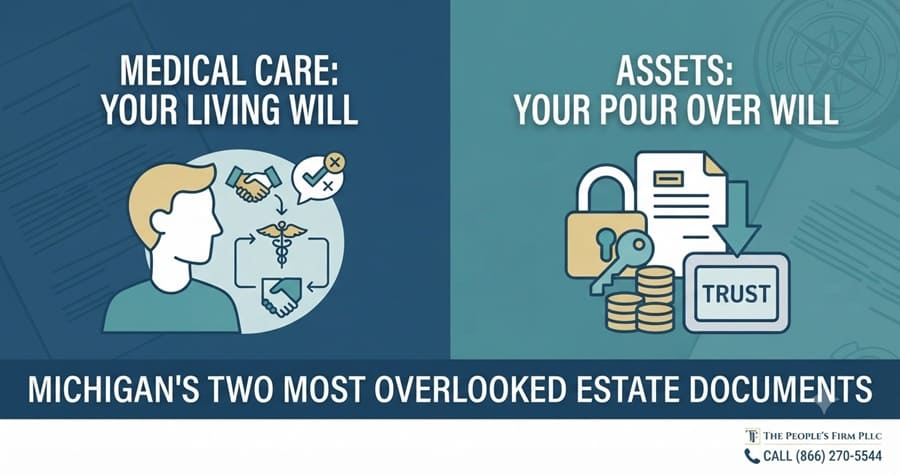
Nobody plans for the hospital call. But it happens, and when it does, your family gets handed two very different problems at once. One is medical. One is financial. And most people in Michigan only prepare for neither.
Here’s the split most families don’t realize until it’s too late. If you end up unconscious or unable to communicate, someone has to decide what treatment you get. That’s a medical question. Separately, if you die and some of your stuff never made it into your trust, someone has to figure out where it goes. That’s a financial question. Different documents solve each one, and confusing them is how families end up in probate court arguing over what mom “would have wanted.”
Let’s take them one at a time.
Your Living Will Isn’t What You Think It Is
Quick reality check, and this one surprises almost everyone. Michigan has never passed a law that makes living wills automatically binding on their own. There’s no statute that says a hospital must follow it. A living will attorney will tell you this upfront instead of letting you assume otherwise, because that’s the honest answer.
So why bother writing one?
Because a living will still does real work. It’s a written record of your wishes about end of life care, things like whether you want to be kept on a ventilator, whether you want feeding tubes, whether you want aggressive treatment or comfort care only. Courts in Michigan have leaned on living wills as strong evidence of intent, even without a dedicated statute behind them. And when you pair a living will with a Durable Power of Attorney for Health Care, which Michigan law does recognize, your patient advocate has something concrete to point to instead of guessing.
Think about what that spares your family. Two siblings arguing in a hospital hallway about whether Dad would have wanted the surgery is one of the worst positions you can put people you love in. A living will doesn’t erase grief. But it takes the guesswork out of it.
A few things worth knowing before you sit down to write one:
- It works best alongside a patient advocate designation, not instead of it
- No family member, insurer, or hospital can force you to have one or dictate its contents
- It should be dated, signed, and witnessed by people who aren’t family, even though state law doesn’t set a formal requirement
- It can cover more than resuscitation. Surgery preferences, autopsy wishes, organ donation, all of it belongs in there
Waiting for a diagnosis before you write this is backwards. The people who benefit most from a living will are the ones who never expected to need one on a random Tuesday.
The Pour Over Will Is Your Trust’s Safety Net
Now the money side. If you’ve set up a revocable living trust, which is the backbone of most solid Michigan estate plans, you probably already know the trust only protects what’s actually titled in its name. That new car you bought last spring? The account you opened and forgot to retitle? If it’s sitting outside the trust when you pass, it doesn’t just disappear into thin air. It ends up in probate, the very process your trust was built to avoid.
That’s the gap a pour over will attorney exists to close.
A pour over will is short, and that’s the point. It doesn’t try to distribute your assets item by item. Instead, it names your trust as the beneficiary of anything left in your individual name at death, and directs the probate court to move those assets into the trust. It’s a catch net, not a primary plan.
Here’s where people get tripped up. A pour over will still has to go through probate for whatever assets it covers. It’s not a way to skip probate entirely. What it does is make sure nothing slips through the cracks and ends up going to the state’s default inheritance rules instead of the people you actually chose. Without one, forgotten assets get distributed as if you never made a plan at all, regardless of what your trust says.
Michigan families who lean heavily on trusts almost always need one of these sitting quietly behind it. It’s cheap insurance against the accounts you forget, the property you inherit later, and the assets you simply never get around to retitling.
Why These Two Belong in the Same Conversation
At first glance, a living will and a pour over will look like they have nothing to do with each other. One is about your body. The other is about your bank account. But they share the same root problem, which is what happens when life doesn’t wait for your paperwork to catch up.
Both documents exist for the moment you can’t speak for yourself, whether that’s because you’re incapacitated or because you’re gone. Both prevent a court, rather than your family, from making the call. And both are the kind of thing people put off because thinking about worst case scenarios feels morbid, right up until a phone call at 2am makes it very, very real.
If you already have a trust, ask yourself honestly whether everything you own is actually titled in it. If the answer is no, or you’re not sure, that’s a pour over will conversation waiting to happen. And if you’ve never written down what kind of medical care you’d want if you couldn’t say it yourself, that’s a living will conversation your family will thank you for someday, even if you never get to hear it.
Estate planning isn’t one document. It’s a handful of quiet decisions that add up to your family never having to guess.
A Final Word
None of this has to be complicated, and it definitely doesn’t have to be expensive to get right. What it does need is someone who will sit down with you, walk through what you actually own and what you actually want, and put it in writing before life forces the issue. Most people who put this off aren’t lazy. They just don’t know where to start, or they assume it’s a bigger project than it is. It isn’t.
If you’re in Michigan and ready to stop guessing, The People’s Firm PLLC can help you get both of these done right.
Dearborn Office 3 Parklane Blvd Suite 1208W Call (313) 914-7783
Lansing Office 108 West Allegan St Call (517) 258-0368
Toll-Free (866) 270-5544


