
A day at a theme park is supposed to be a highlight of summer. The rides, the food, the laughter, most visits end with tired feet and happy memories. But for thousands of Americans each year, the trip ends with an emergency room visit instead.
When that happens, many injured guests are left with the same pressing question: Does signing the park entry ticket mean you gave up your right to sue? In most cases, the answer is no, and understanding why can make a real difference in what compensation you are able to recover.
This article breaks down how the duty of care applies to amusement parks, the most common causes of ride malfunctions, how Texas courts treat liability waivers, and what evidence you need to build a strong premises liability case.
How Many People Are Injured at Amusement Parks Each Year?
The scale of amusement park injuries in the United States is larger than most people expect.
According to the U.S. Consumer Product Safety Commission (CPSC), roughly 30,000 amusement park-related injuries are reported annually across the country. The International Association of Amusement Parks and Attractions (IAAPA) places the injury rate at approximately 3.7 per million visitors, a figure that sounds small but translates to thousands of real people with real harm every single year.
For those injured in Texas, knowing whether these numbers translate into a valid legal claim requires speaking with an experienced Houston amusement park injury lawyer who can evaluate the specific facts of what happened.
Key statistics from verified sources:
- Children between the ages of 5 and 14 account for nearly 50% of all amusement park ride injuries (CPSC).
- Head and neck injuries make up approximately 18% of all reported ride incidents.
- Roller coasters account for around 10% of all ride-related injuries nationally.
- Mechanical failure causes approximately 27% of amusement ride accidents, while operator error accounts for another 15% (Gitnux, 2026).
- From 1990 to 2010, an estimated 92,885 children under 17 were treated in U.S. emergency rooms for amusement ride injuries, averaging about 4,423 injuries per year.
The Legal Foundation: What Duty of Care Means at a Theme Park
When you buy a ticket to an amusement park, you become what Texas law calls an “invitee”, a paying guest invited onto the property for commercial purposes. That classification carries significant legal weight.
Under premises liability law, amusement parks owe their guests the highest duty of care among visitor categories. That duty includes a legal obligation to:
- Inspect rides, walkways, and facilities regularly
- Repair or remove known hazards promptly
- Warn guests of dangers that are not obvious
- Properly train ride operators and safety staff
- Maintain adequate security to prevent foreseeable harm
This framework means that if a park fails to uphold any one of these duties and a guest is harmed as a direct result, the park may be held liable. The duty does not disappear because a ride is inherently thrilling; it exists precisely because parks profit from putting guests in positions of physical risk.
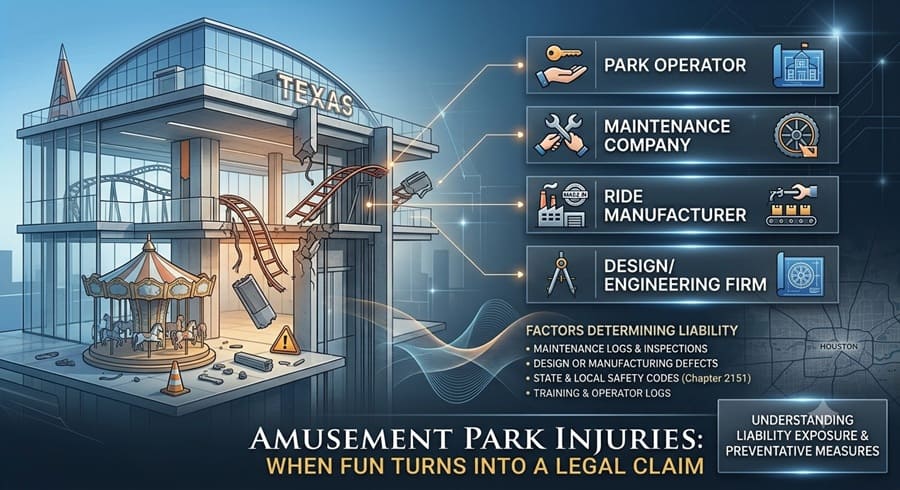
Texas law reinforces this through the Texas Occupations Code Chapter 2151, which requires all amusement park rides to display a valid compliance sticker as proof of regulatory adherence. The Texas Department of Insurance oversees this process, and a missing or expired sticker can itself be a factor in establishing negligence.
What Causes Ride Malfunctions? The Most Common Culprits
Not every amusement park accident is the result of careless behavior by a guest. In a significant number of cases, the fault lies with the park itself, through mechanical problems, poor maintenance, or operational failures.
Mechanical and Structural Failures
Rides are complex machines with hundreds of moving components. When any one of those components is defective, improperly installed, or simply worn down from repeated use without replacement, the result can be catastrophic. Faulty restraint systems, broken track joints, and hydraulic failures have all been linked to serious injuries and fatalities in documented incidents.
Poor Maintenance and Inspection Gaps
Parks are legally required to maintain their rides in safe operating condition. When inspections are skipped, corners are cut on repairs, or warning signs are ignored by maintenance crews, the park takes on direct responsibility for whatever harm follows. Courts have consistently held that a park cannot argue it “did not know” about a defect when evidence shows inspections were inadequate or overdue.
Operator Error
Human error on the part of ride operators accounts for a meaningful portion of accidents each year. This includes failing to secure restraints before a ride launches, allowing a ride to cycle with a guest in an unsafe position, or overriding safety systems to save time. Since operators act as agents of the park, their negligence is directly attributed to their employer.
Design Defects
Some rides are dangerous not because of poor maintenance but because of how they were designed in the first place. Defective design claims target the manufacturer of the ride rather than the park itself, although parks can share liability if they knew about a design flaw and failed to address it or warn guests.
Guest Safety Instruction Failures
Parks also have a duty to communicate safety rules clearly. Inadequate height or weight restriction enforcement, poorly visible safety signage, and ride operators who fail to give verbal instructions before a launch can all contribute to preventable accidents.
Understanding the cause of the accident is only part of the equation. How you respond in the days that follow matters just as much. Many injury claims are weakened not by the accident itself, but by avoidable missteps afterward, a point covered in detail in this guide on mistakes that can ruin a personal injury claim.
Are Liability Waivers Enforceable in Texas?
This is one of the most misunderstood aspects of amusement park law. Many guests assume that because they clicked “agree” on an online form or signed a paper at the gate, they have no legal recourse if they are injured. Texas courts do not see it that way.
What Makes a Waiver Valid in Texas
Texas courts will only enforce a liability waiver if it meets two specific legal standards: the express negligence doctrine and the conspicuousness requirement.
Under the express negligence doctrine, a waiver must explicitly and unambiguously state that the signer is releasing the park from liability for the park’s own negligence. Vague language, overly broad catch-all terms, or buried disclaimers are routinely challenged and struck down.
The conspicuousness requirement means the waiver must be clearly visible. It cannot be hidden in fine print on the back of a ticket or buried in a lengthy online terms-of-service agreement. Courts have invalidated waivers that guests were reasonably unable to see or read before signing.
When Waivers Do Not Protect the Park
Even a properly drafted waiver has clear limits in Texas. A waiver cannot shield a park from liability when:
- The park engaged in gross negligence, conduct that goes beyond ordinary carelessness and reflects a conscious disregard for guest safety
- The waiver was signed by a parent on behalf of a child, Texas courts generally hold that a parent cannot legally waive a minor’s personal injury claims, including claims for pain, suffering, and mental anguish
- The park concealed a known hazard or actively misrepresented safety conditions
- The language of the waiver does not specifically address the type of accident that occurred
In other words, signing a waiver at the gate does not automatically close the door on a legal claim. An attorney can examine the specific language of the document, the circumstances of the accident, and the applicable Texas law to determine whether the waiver holds up.
What Evidence Do You Need to Build a Strong Premises Liability Case?
A premises liability claim following an amusement park injury rises or falls on evidence. The stronger and more complete your documentation, the better positioned you are to prove that the park’s negligence caused your harm.
Immediate Steps After an Amusement Park Injury
The actions you take in the hours immediately after an accident have a direct impact on the strength of your claim. If you are physically able to do so:
- Seek medical attention right away, even if the injury seems minor; delayed treatment is one of the most common arguments insurers use to minimize claims
- Report the incident to park management and request a copy of the official incident report
- Take photos and video of the ride, the area where the injury occurred, any visible hazards, and your injuries
- Collect the names and contact information of any witnesses
- Do not give a recorded statement to park representatives or their insurance company without consulting an attorney first
Key Evidence in a Theme Park Injury Case
Beyond the immediate scene, a thorough premises liability case typically relies on:
- Maintenance and inspection records for the ride involved
- Operator training logs and certification records
- Prior incident reports involving the same ride
- Surveillance footage from park cameras
- Expert testimony from ride safety engineers or mechanical specialists
- Medical records documenting the nature and extent of injuries
- Proof of damages, including medical bills, lost income, and impact on quality of life
One of the most important things to understand is that parks are not obligated to preserve evidence indefinitely. Footage gets overwritten. Maintenance logs get updated. The sooner you engage legal representation, the sooner your attorney can send a legal hold notice demanding that the park preserve all relevant records.
PAA: Common Questions About Amusement Park Injury Claims
Can I sue an amusement park if I signed a waiver?
Possibly, yes. In Texas, waivers must meet strict requirements to be enforceable, and they cannot protect a park from claims involving gross negligence or injuries to minors. An attorney can review the specific language of the waiver and the facts of your case to advise on your options.
What is the statute of limitations for an amusement park injury in Texas?
Under Texas Civil Practice and Remedies Code Section 16.003, you generally have two years from the date of the accident to file a personal injury lawsuit. Missing this deadline typically means losing the right to pursue compensation entirely. If a child was injured, specific rules about when the clock starts may apply.
Who can be held liable for an amusement park accident?
Liability can extend to the park operator, the ride manufacturer (in cases of design or manufacturing defects), third-party maintenance contractors, and individual employees whose negligence directly contributed to the accident. An attorney can investigate the full chain of responsibility.
What compensation can I recover after a theme park injury?
Depending on the circumstances, compensation may include past and future medical expenses, lost wages, reduced earning capacity, pain and suffering, emotional distress, and, in cases involving fatalities, wrongful death damages for surviving family members.
Protecting Your Rights After a Theme Park Accident
Amusement parks are run by large companies with experienced legal teams and insurance departments whose primary job is to limit what they pay out on injury claims. That imbalance makes legal representation critical.
If you or someone you love was injured at a theme park in Texas, understanding your rights under premises liability law is the first step. Making mistakes in the early days after an accident, talking to insurers without counsel, failing to preserve evidence, or missing the filing deadline, can permanently compromise your ability to recover fair compensation.


